

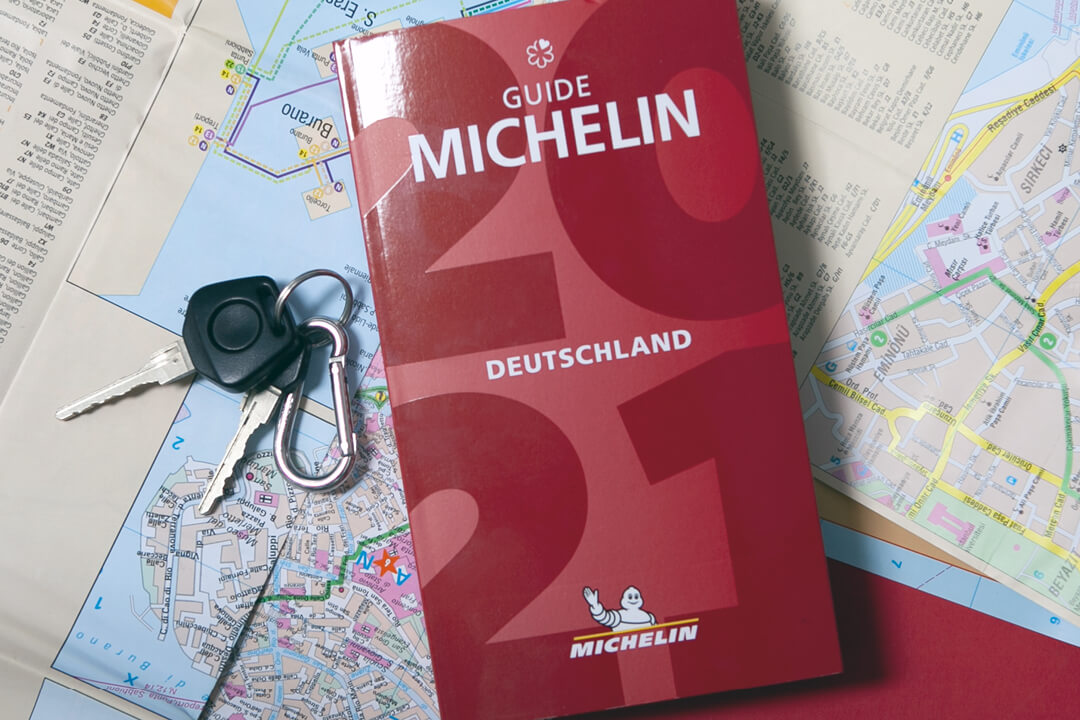

Vehicle registration, driver’s license, Michelin Guide? Let’s go!
Our favorite book has a red cover, but more and more often it’s only available in digital format
The first GPS for workshop and hungry motorists
Long before any trip begins, the anticipation starts with a glance at the MICHELIN GUIDE. It’s best known for awarding Michelin stars, but it offers much more: reliable information about culinary highlights on both sides of the street in a wide variety of categories.
The brothers Andre and Edouard Michelin, owners of the Michelin tire factory, published the first GUIDE MICHELIN in 1898 for the approximately 3000 motorists who existed in France at that time. The GUIDE MICHELIN showed them where they could find garages on their road trip.

So it made sense to include on the maps not only repair shops where you could have your car serviced, but also restaurants where you could expect good food.
Since a glass of Sancerre or Bordeaux is a must with any meal in France, accommodations were also included in the Michelin Guide. Today, these hotels can be found in the Tablet Hotels app.
Some things cannot be improved
The GUIDE MICHELIN gets along in the paper form with maps, texts and symbols. It focuses on the quality and characteristics of restaurants and hotels. That’s what makes him so likeable.
No food styling, no photo gallery with interchangeable images that almost always show a model couple toasting with a glass of wine.
Pure information that will make anyone’s mouth water who is excited about food.
Paper vs. App
The MICHELIN GUIDE is now also available as an app—and it’s even free. In the past, we’d only used the app as a supplement, since we find the print version of the MICHELIN GUIDE far more efficient. However, for an increasing number of countries, the information in the MICHELIN GUIDE is now available exclusively in digital format.
As with many apps, you spend more time with the GUIDE MICHELIN app than originally planned.
In the app, the restaurant’s web pages are linked, there you take a look at the menu and the picture gallery, click the one or other video and quickly lost the overview and a lot of time. In the end, you book enervated after a rather unsystematic search process or put the cell phone aside annoyed.
Enjoyable hiking on the map
In the paper version, you start by looking at the overall map of the country, then move on to the sub-maps of each region. There are marked hotels and the restaurants that have been awarded one, two or three stars.
The map also features excellent restaurants serving regionally inspired cuisine, known as Bib Gourmands. Their symbol is the ever-smiling face of Bibendum, the Michelin Man.
Bib Gourmands usually have an excellent price/quality ratio. We have never been disappointed and often delighted.
The practiced reader of the Guide Michelin can tell at a glance whether his next car trip will take him through an area that doesn’t have much to offer in the way of cuisine, or whether there will be plenty of culinary highlights.
Culinary clusters are interesting. In areas where there are a large number of starred restaurants, you can often find less expensive restaurants run by former employees of starred restaurants. With a lot of ambition and diligence, many are working to achieve their first own star. Often an excellent choice.
In the best case all three shine
The famous tire man Bibendum, brand symbol of the tire factory Michelin beams to this day with a happy smile from the GUIDE MICHELIN. It has been slimmed down in recent decades, but its positive aura has remained the same.

Once a guest has found an excellent restaurant thanks to the information provided by the Guide Michelin, he wears the same smile on his face.
You can also see smiles on the faces of all the chefs who have been awarded their first Michelin star by the MICHELIN GUIDE.
The criteria for awarding the stars
The Michelin Guide’s inspectors travel anonymously on behalf of the Michelin Guide. Reservations are made under different names, cell phone numbers are changed regularly, and an inspector who has visited a particular region is not allowed to return to that region for 10 years.
The tester is on the road for about 28 weeks a year, taking eight to ten meals in a week. The testers eat alone in the restaurant, which nowadays does not necessarily arouse suspicion, and are required to write a detailed, multi-page report about their impressions of the restaurant after the meal.
Restaurants listed in the GUIDE MICHELIN are regularly reviewed. Especially when it comes to awarding or removing a star, different testers visit the restaurants before the star decision is determined.
For most ambitious chefs, earning a Michelin star is a dream come true. This increases awareness enormously and the number of table bookings goes steeply upwards for the time being.
However, with a star comes increased pressure to at least maintain that star, if not improve upon it. Losing a star is a bitter blow.
The Guide Michelin’s official criteria for awarding stars are:
- Product quality
- Chef know-how
- Sensitivity to aromas
- Originality of the dishes
- Consistency and consistent quality
To those in the know, it’s clear that the service, the atmosphere, and the wine cellar also play an important role. And rightly so, because a restaurant visit is only a success if the service is outstanding. And if you’re lucky enough to encounter a knowledgeable sommelier, the experience is perfect.
Ambitions for a star mean a not inconsiderable investment for every restaurant, in the wine cellar, in cutlery, crockery and many other details, which quickly add up to a not inconsiderable sum and must be earned through hard work, high-quality use of goods and satisfied guests.
The statement “I’m not interested in a star rating, but only in satisfied guests” sounds good, but is often nothing more than a desire for a higher profit margin.
Discipline. Discipline. Discipline.
Anyone who has ever had a glimpse into the kitchen of an ambitious restaurant or has a chef in their circle of friends knows how much day-to-day discipline and skill it takes to produce consistently high quality in a restaurant kitchen.
Menu sequences where every longer pause in between can already lead to criticism, tables that blithely order à la carte and yet expect every dish at the table at exactly the same time, more and more special requests due to allergies and yet the fish and meat must be served exactly with the desired degree of cooking and the plate must look creative.
In any industry, quality is determined by the best. The same is true for the restaurant industry. Of course, quality is also always subjective and some days a plain good buttered bread satisfies all desires.


From Belgium to Washington, D.C.
The Michelin Guide is available for many countries, but not all of them. In Austria, for example, the Michelin Guide focuses on the cities of Vienna and Salzburg and lists just a handful of restaurants in Carinthia and Vorarlberg.
Guide Michelins, which list not only the largest cities but the entire country, such as France, of course, but also Italy, the Netherlands or Switzerland are rare and the purchase is worthwhile in any case.
Especially when driving through unfamiliar areas and hunger sets in, reaching for the GUIDE MICHELIN is a safe bet.
You can see what choices you have in each region, get an idea of the style of cuisine by listing some dishes. Symbols such as guest garden are very welcome in the summer and the price of the menu gives an idea of the price level. It is also always important to look at the restaurant’s days off.
Whether a simple inn or a star restaurant. At both, you can be lucky and get a table at short notice, especially at lunchtime, because someone canceled.
The MICHELIN GUIDE has also led us to fantastic experiences on the spur of the moment while passing through many European countries, because very good restaurants are often located in industrial parks or other areas where you wouldn’t necessarily expect to find them.
Tablet – Michelin’s digitization for hotels
In December 2018, GUIDE MICHELIN adopted the Tablet digital hotel guide. Here, digitization has many advantages, because the excellent image quality, the detailed description of the hotel and the sometimes themed selection of hotels (hotels for nature lovers, hotels in secluded areas, hotels with grandiose pools, etc.) arouse curiosity about a new vacation destination.
Once you’ve decided, you can further heighten your anticipation by picking up the GUIDE MICHELIN and creating your own individual dream list of restaurant delights.
Star and asterisk
A tip for great enjoyment on a smaller budget: some star restaurants have a second branch. Sometimes even in the same building only with a somewhat simpler ambience.
If you reserve a table there, you can benefit from the rigid discipline and quality of the chefs, who are often trained and operate in the same kitchen, and get excellent pleasure on the plate at a comparatively much lower price.
We’ve had nothing but great experiences on the route from Bruges to Zweiflingen.
Are there any other guides?
Of course. There are so many, and the number keeps growing. Ultimately, it’s a matter of taste. We’ve experimented with everything from Gault Millau to Zagat, but in the end, we’ve always come back to the Red Book.
Depending on the specifics of the country’s cuisine, we sometimes use second guides and have, for example, discovered many a good osteria in Italy with Slow Food. Our culinary love belongs to the reliable GUIDE MICHELIN. Too many wonderful memories are stuck between the red book covers.
#Advertisement #IndependentGMEmpfehlung #BecauseWeLoveIt
Photographs © GloriousMe
