


Strategy for Success
This year, the independent nation of Singapore turns 61. In this short time, it has evolved from a developing country into one of the safest and wealthiest nations on earth. What was the key to its success?
Boring? Yes and no
16.91 million tourists visited Singapore in 2025. Most of them stay only a few days as part of a stopover before continuing on to Australia, New Zealand, or a cruise ship.
When considering whether to make a stopover in Singapore or another “halfway” destination with a large international airport, people used to often say, “Clean and safe, but a bit boring, with no local flavor.”
Yet that is precisely the key to Singapore’s success. In the span of 61 years, the country has transformed itself from a small city-state that was largely made up of slums into one of the most attractive countries in the world.
Rightfully proud of a great achievement
GloriousMe had also just been back in town. Every taxi driver spoke with great pride about what Singapore is currently working on and what new developments have taken place in recent years.

It was everywhere: well-maintained residential complexes stretching for kilometers, trees, parks, high-rises with integrated gardens, perfect streets, architectural highlights left and right, and joggers running along the river without a care before and after sunset. The heavy traffic flows like clockwork: no honking, no cutting in line, no double or triple parking.

None of this can be taken for granted in an Asian metropolis.
The Start
Sir Stamford Bingley Raffles, an English officer who also served as governor of the then Dutch East Indies for five years, was one of the first to recognize the strategic importance of Singapore’s location at the strait connecting the South China Sea and the Indian Ocean.
In 1819, he succeeded in claiming Singapore for the British Crown. In 1867, Singapore became a British Crown Colony. In 1963, Singapore left the British Empire. Initially, Singapore formed a federation with neighboring Malaysia. When differences of opinion regarding the country’s future became too great, then-Prime Minister Lee Kuan Yew declared Singapore an independent state in 1965.
 Statue of Sir Thomas Stamford Raffles on North Boat Quay in Singapore © Alamy Stuck Photo
Singapore enjoys an excellent strategic location. But as we know from recent history, such a location—as the case of Odessa , Ukraine, shows—is easily subject to territorial claims by envious, belligerent neighbors.
The young country had no natural resources in the form of mineral deposits, nor did it have oil or natural gas reserves like, for example, the United Arab Emirates. Drinking water was—and still is—scarce; the majority of the population, consisting mainly of Malays and Chinese, lived in slums, and the level of education was low.
Today, Singapore is one of the wealthiest countries in the world. Its nominal gross domestic product per capita was approximately $99,365 in 2025 and is estimated to reach $150,908 in 2026. This is nearly twice as high as in Germany (bpb, Federal Agency for Civic Education).
Strategy is highly valued here
Singapore is a city-state with a population of just under 6 million. At this point, at the latest, many people breathe a sigh of relief and think they have nothing to learn from Singapore’s development, because this small country is not comparable to their own. They’re making it too easy on themselves. Because even in Singapore, the saying holds true: You can’t make something out of nothing.
Lee Kuan Yew, the long-serving prime minister, developed a strategy for his country in which he outlined a path to development with specific goals. He had devised this plan together with Dutch economist Albert Winsemius, an employee of the United Nations.
The strategy was not a classified document; rather, it was accessible to everyone. It was clear to see which areas were identified as growth sectors for the state and what the individual steps should look like to achieve this growth. It was equally clear to see how political leaders were achieving the respective interim goals.
On paper, anything is possible; with an authoritarian leadership style in a democratic country, Prime Minister Lee Kuan Yew consistently implemented this plan. He also made it clear what he did not want:
- No corruption
- No Communists
- No Chaos
He made his country’s civil service attractive by offering high salaries, and he had the picturesque old residential neighborhoods—where malaria and dengue fever were rampant—demolished.


He established a stable environment for foreign investors and made massive investments in housing and education. For decades, Singaporean students have consistently ranked at the top of many math proficiency rankings.
The stable framework and ongoing efforts to attract international companies paid off. Stability, a focus on the economy and the future, and an attractive tax system drew companies and talented employees to the country.
Boring? Yes, please
Expatriates who hold demanding jobs in one of the neighboring Asian countries are happy that their families can live in pleasant Singapore and are happy to commute via Changi Airport.
Even in the city-state, things weren’t always rosy. No one can remain isolated from developments in global trade and international political issues. Strategic adjustments were necessary—but knee-jerk reactions and populism never prevailed.
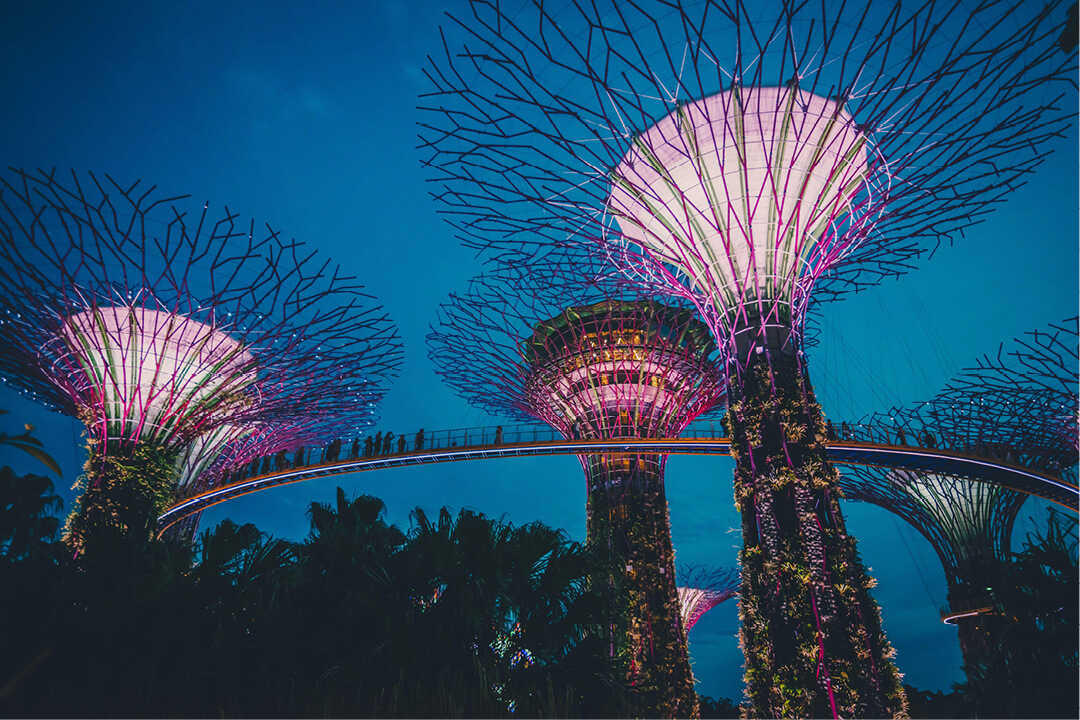
Singapore has never stood still. Anyone who, like us, has visited the city time and again over the past few decades has been able to witness this firsthand, and the fantastic Gardens by the Bay are just one sign of this city’s prosperity, which is rooted in achievement.
Anyone who comes from a country where the word “strategy”—especially in politics—seems to be frowned upon feels like they’re in the wrong movie and hopes for a happy ending.
The statue of Sir Raffles in Singapore doesn’t need to be protected by a fence. The Raffles Hotel, opened in 1887 by the Armenian Sarkies brothers, is once again radiant after a major renovation. It holds its own among modern hotel buildings that stand out for their “eco-elegance,” such as the Park Royal Pickering, or The Warehouse, a modern design hotel housed in a former warehouse for spices like nutmeg and other seasonings that once played such an important role in the history of this part of Asia.

#Advertising #ProductPlacement #IndependentRecommendation #BecauseWeLoveIt
Cover photo: The Supertrees at the Gardens by the Bay attraction in Singapore © Alamy Stock Photo
